
1. What Is Low-Pressure Die Casting?
Low-pressure die casting (LPDC) is a metal manufacturing process that uses controlled, relatively low gas pressure to push molten metal from a sealed holding furnace into a reusable metal mold.
Unlike gravity casting, which relies on gravity to fill the mold cavity, LPDC uses regulated pressure to deliver molten metal through a riser tube into the mold from below. This controlled filling method reduces turbulence, minimizes air entrapment, and helps produce castings with good internal quality and consistent mechanical properties.
The pressure is generally maintained throughout the initial solidification stage, allowing additional molten metal to feed the casting and compensate for solidification shrinkage.
Low-pressure die casting is widely used for aluminum and magnesium alloy components, particularly in automotive, aerospace, industrial machinery, and transportation applications.
Typical products include aluminum wheels, suspension components, motor housings, pump bodies, and other parts requiring good strength, dimensional accuracy, and structural integrity.
Compared with conventional high-pressure die casting, LPDC generally has a slower production cycle but offers better control over metal flow and solidification. This makes it particularly suitable for components where mechanical performance and internal quality are important.
2. How Does the Low-Pressure Die Casting Process Work?
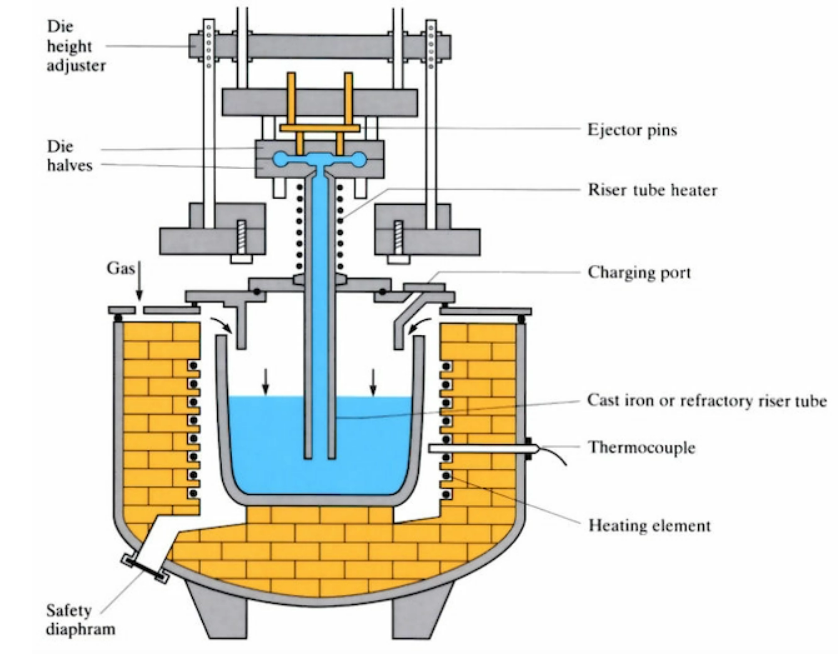
Low-pressure die casting involves several controlled manufacturing stages. The process requires specialized equipment, including a melting furnace, holding furnace, riser tube, casting die, and pressure control system.
Step 1: Mold Design and Preparation
The process begins with designing and manufacturing a reusable metal mold, typically made from heat-resistant tool steel.
The mold consists of two or more sections that form the required cavity. It also includes cooling channels, vents, and other features to control metal flow and solidification.
Before casting, the mold is cleaned, inspected, and preheated to an appropriate temperature. A suitable mold coating or release agent may also be applied to protect the mold surface and facilitate casting removal.
Step 2: Melting the Metal Alloy
The selected metal alloy, commonly aluminum or magnesium, is melted in a furnace until it reaches the required casting temperature.
The molten metal must be carefully controlled to maintain the correct temperature and chemical composition.
Degassing and metal cleaning treatments may be performed to remove hydrogen and non-metallic inclusions, helping reduce porosity and improve casting quality.
Step 3: Transferring Molten Metal to the Holding Furnace
The molten metal is transferred into a sealed holding furnace positioned beneath the casting mold.
A ceramic or refractory-lined riser tube connects the holding furnace to the mold cavity.
The holding furnace maintains the molten metal at a stable temperature and provides the controlled environment needed for the low-pressure filling process.
Step 4: Applying Low Pressure and Filling the Mold
Once the mold and molten metal are ready, compressed air or an inert gas is introduced into the holding furnace.
The applied pressure pushes molten metal upward through the riser tube and into the mold cavity.
The pressure is carefully regulated to ensure smooth and controlled filling, minimizing turbulence, oxidation, and gas entrapment.
The filling speed and pressure profile depend on the alloy, mold design, component geometry, and required casting quality.
Step 5: Solidification Under Pressure
After the mold cavity is filled, the applied pressure is maintained while the molten metal begins to solidify.
This continued pressure allows additional liquid metal to feed areas experiencing solidification shrinkage, reducing the risk of shrinkage cavities and improving casting density.
Cooling channels within the mold help control the solidification sequence and promote directional solidification.
Step 6: Pressure Release and Casting Removal
Once the casting has solidified sufficiently, the pressure is gradually released.
The remaining molten metal in the riser tube flows back into the holding furnace, where it can be reused in subsequent production cycles.
The mold is then opened, and the finished casting is removed using an ejection mechanism.
Step 7: Trimming, Machining, and Inspection
After removal, excess material such as gates and flash is trimmed.
Depending on the application, additional operations may include CNC machining, heat treatment, surface finishing, and dimensional inspection.
The finished components are checked for surface defects, internal porosity, dimensional accuracy, and mechanical properties to ensure compliance with product specifications.
3. Main Equipment Used in Low-Pressure Die Casting
A complete LPDC production line consists of several essential systems that work together to maintain stable metal temperature, controlled pressure, and consistent casting quality.
Melting Furnace
The melting furnace heats the selected alloy to its required molten state. Temperature control is essential for maintaining metal fluidity and preventing casting defects.
Holding Furnace
The holding furnace stores molten metal beneath the mold and maintains a stable temperature throughout the casting cycle. It also provides the sealed environment needed for pressure-controlled metal delivery.
Riser Tube
The riser tube connects the holding furnace to the mold cavity. It guides molten metal upward during filling and allows unused liquid metal to return to the furnace after pressure release.
Casting Die
The casting die forms the shape of the finished component. It is usually manufactured from heat-resistant steel and incorporates cooling channels, vents, and ejection mechanisms.
Pressure Control System
The pressure control system regulates gas pressure inside the holding furnace. Accurate control is important for achieving smooth filling, proper feeding, and consistent solidification.
Cooling System
Cooling channels and temperature-control equipment help regulate the mold temperature and solidification process, reducing the risk of shrinkage defects and dimensional variation.
4. Materials Used in Low-Pressure Die Casting
Low-pressure die casting is particularly suitable for non-ferrous alloys with good casting characteristics.
4.1 Aluminum Alloys
Aluminum is the most widely used material in low-pressure die casting because of its low density, good corrosion resistance, thermal conductivity, and favorable strength-to-weight ratio.
Common aluminum casting alloys include A356, A357, and other application-specific Al-Si-Mg alloys.
Typical applications include:
Suspension components
Steering system housings
Engine and transmission components
Electric motor housings
Pump and valve bodies
Aluminum alloys are especially suitable for components requiring a combination of lightweight construction, mechanical strength, and dimensional stability.
4.2 Magnesium Alloys
Magnesium alloys are among the lightest structural metals used in manufacturing.
Their low density and good strength-to-weight ratio make them attractive for automotive and aerospace components where weight reduction is a priority.
Typical applications include:
Steering wheel structures
Transmission housings
Electronic equipment enclosures
Automotive interior structures
Lightweight machinery components
Magnesium requires appropriate process controls and surface protection to address oxidation and corrosion-related concerns.
4.3 Other Metal Alloys
Low-pressure casting principles can also be applied to other alloy systems, depending on the equipment and mold technology.
However, conventional low-pressure die casting with reusable metal dies is primarily associated with aluminum and magnesium alloys.
For higher-melting-temperature materials, such as steel and certain copper alloys, specialized casting equipment and mold systems are required.
5. Advantages of Low-Pressure Die Casting
Low-pressure die casting offers several important benefits, particularly for components requiring good internal quality, mechanical performance, and repeatable dimensions.
5.1 Reduced Porosity and Better Internal Quality
One of the main advantages of LPDC is its controlled metal-filling process.
Molten metal enters the mold gradually from the bottom rather than falling freely from above. This reduces turbulence and helps minimize air entrapment and oxide-film formation.
Maintaining pressure during solidification also helps compensate for metal shrinkage, reducing the likelihood of shrinkage cavities.
However, proper melt treatment, mold venting, and process control remain essential because LPDC does not eliminate all forms of porosity.
5.2 Improved Mechanical Properties
The controlled filling and feeding process can produce castings with relatively dense and consistent internal structures.
Combined with suitable alloy selection and cooling conditions, LPDC can achieve good tensile strength, elongation, fatigue performance, and structural reliability.
These properties make it suitable for automotive wheels, suspension components, and other mechanically demanding applications.
5.3 Excellent Dimensional Consistency
The reusable metal mold provides stable cavity dimensions across repeated production cycles.
Combined with controlled filling and solidification, this helps manufacturers achieve consistent component geometry and dimensional accuracy.
This is particularly important for automotive parts that require precise assembly and reliable performance.
5.4 Good Surface Finish
The smooth surface of the metal mold produces castings with relatively good surface finishes compared with conventional sand casting.
This can reduce the need for extensive grinding, polishing, and other finishing operations.
5.5 Efficient Material Utilization
Because molten metal is supplied directly from the holding furnace through the riser tube, unused metal can return to the furnace after solidification.
This helps reduce the amount of discarded gating and runner material compared with some other casting methods.
5.6 Suitable for Complex Components
LPDC can produce components with relatively complex geometries, varying wall thicknesses, and integrated structural features.
The controlled filling process allows molten metal to enter the mold cavity smoothly, supporting the production of components with demanding design requirements.
6. Disadvantages and Limitations of Low-Pressure Die Casting
Despite its benefits, low-pressure die casting has several limitations that manufacturers should consider before selecting the process.
6.1 Higher Initial Equipment Investment
LPDC requires specialized equipment, including a sealed holding furnace, pressure control system, riser tube, and reusable metal molds.
The initial investment is generally higher than conventional sand casting and some gravity casting setups.
Therefore, it is more economical for projects with sufficient production quantities and stable product designs.
6.2 Relatively Slow Production Cycle
Compared with high-pressure die casting, LPDC generally has a longer filling and solidification cycle.
The gradual filling process and controlled cooling requirements can reduce production speed.
For applications requiring extremely high output and short cycle times, high-pressure die casting may be more suitable.
6.3 Limited Thin-Wall Capability
LPDC generally has less capability than high-pressure die casting when producing extremely thin-walled components.
The metal must fill the mold at a controlled rate without premature solidification. Very thin sections and highly intricate geometries may therefore require alternative casting processes.
Actual minimum wall thickness depends on alloy fluidity, component geometry, mold temperature, and process parameters rather than a single universal limit.
6.4 Mold and Equipment Maintenance
The mold, riser tube, and furnace components are repeatedly exposed to high temperatures and molten metal.
Thermal fatigue, erosion, oxidation, and surface deterioration may occur over time.
Regular inspection and maintenance are necessary to ensure stable production quality and extend equipment service life.
6.5 Limited Material Compatibility
Conventional LPDC is mainly used for aluminum and magnesium alloys.
It is less suitable for many high-melting-temperature metals because of the thermal requirements imposed on the mold, riser tube, and equipment.
6.6 Higher Unit Costs for Small Production Runs
Although LPDC can offer good long-term production economics, tooling and equipment costs may make it less competitive for small batches.
For prototypes or limited production quantities, sand casting or other flexible manufacturing methods may be more economical.
7. Applications of Low-Pressure Die Casting
Low-pressure die casting is widely used in industries that require reliable metal components with good mechanical properties and dimensional consistency.
7.1 Automotive Industry
The automotive industry is one of the largest application areas for low-pressure die casting.
Common components include:
Aluminum alloy wheels
Suspension components
Steering system housings
Transmission housings
Engine-related components
Structural brackets
Selected chassis components
Aluminum wheels are a particularly important LPDC application because the process supports controlled metal filling, good feeding during solidification, and consistent mechanical properties.
7.2 Electric Vehicle Manufacturing
The growing electric vehicle market has increased demand for lightweight aluminum components.
LPDC can be used for selected EV components, including:
Electric motor housings
Gearbox housings
Suspension components
Structural brackets
Battery system support components
Power electronics housings
Material selection and process optimization are essential to ensure that these parts meet the required strength, fatigue, thermal, and dimensional specifications.
7.3 Aerospace Industry
Aerospace manufacturers require lightweight components with reliable mechanical properties and strict quality control.
Selected aluminum and magnesium castings produced using low-pressure techniques can be used in aircraft equipment housings, brackets, structural supports, and other specialized components.
The process and material specifications must meet the applicable aerospace qualification and inspection requirements.
7.4 Industrial Machinery
Low-pressure casting is also suitable for various industrial applications, such as:
Pump housings
Valve bodies
Compressor components
Motor housings
Hydraulic equipment parts
Machinery brackets
The process provides a useful combination of dimensional consistency, mechanical performance, and production repeatability.
7.5 Electrical and Electronic Equipment
Aluminum castings are used in selected electrical and electronic applications because of their thermal conductivity, corrosion resistance, and relatively low weight.
Typical components include motor housings, heat-dissipation structures, and equipment enclosures.
8. Low-Pressure Die Casting vs. High-Pressure Die Casting
Both low-pressure and high-pressure die casting use reusable metal molds, but they differ significantly in metal-filling methods, pressure levels, production speeds, and typical applications.
| Comparison | Low-Pressure Die Casting | High-Pressure Die Casting |
|---|---|---|
| Filling method | Pressure pushes metal upward through a riser tube | Molten metal is injected at high speed into the die |
| Pressure | Relatively low, commonly below 1 bar above atmospheric pressure | High injection pressure, often tens to hundreds of MPa |
| Filling speed | Relatively slow and controlled | Very fast |
| Solidification | Pressure maintained to feed shrinkage | Rapid solidification under high pressure |
| Internal quality | Generally good when properly controlled | Gas porosity can be a concern |
| Mechanical properties | Often suitable for demanding structural applications | Depends on alloy, process, and casting design |
| Wall thickness | Better suited to moderate wall thicknesses | Better suited to thin-walled components |
| Cycle time | Generally longer | Generally shorter |
| Production volume | Medium to high | High to very high |
| Typical applications | Aluminum wheels, suspension parts, structural components | Engine covers, transmission housings, electronic enclosures |
Which Process Should You Choose?
Choose low-pressure die casting when:
Internal casting quality is a major priority.
Good mechanical properties and structural reliability are required.
The component has moderate wall thickness.
Controlled metal filling and feeding are important.
Production quantities justify the tooling investment.
Choose high-pressure die casting when:
High production speed is required.
Components have thin walls and complex geometries.
Large production volumes are expected.
Good dimensional accuracy and surface finish are priorities.
The component design is compatible with high-pressure filling.
Neither process is universally better. The final choice depends on alloy specifications, component geometry, performance requirements, production volume, and total manufacturing cost.
9. Low-Pressure Die Casting vs. Gravity Casting vs. Sand Casting
Low-pressure die casting is one of several methods used to manufacture metal components. Comparing the major processes helps manufacturers select the most appropriate solution.
| Comparison | Sand Casting | Gravity Die Casting | Low-Pressure Die Casting |
|---|---|---|---|
| Mold type | Expendable sand mold | Reusable metal mold | Reusable metal mold |
| Filling method | Gravity | Gravity | Controlled gas pressure |
| Initial tooling cost | Low | Medium to high | Medium to high |
| Surface finish | Relatively rough | Good | Good |
| Dimensional accuracy | Moderate | Good | Good |
| Internal quality | Depends on process control | Depends on filling and feeding design | Generally good with proper pressure feeding |
| Production speed | Relatively slow | Moderate | Moderate |
| Typical production volume | Low to medium | Medium to high | Medium to high |
| Common applications | Large housings, engine blocks | Pump bodies, housings, wheels | Aluminum wheels, suspension parts |
Choosing the Right Casting Method
Sand Casting: Suitable for large components, complex internal cavities, prototypes, and low-volume production.
Gravity Die Casting: Suitable for repeatable production of non-ferrous components with good surface quality and mechanical properties.
Low-Pressure Die Casting: Suitable for components requiring controlled filling, reliable feeding, good internal quality, and consistent mechanical performance.
10. Quality Control in Low-Pressure Die Casting
Quality control is essential for ensuring that finished castings meet the required mechanical, dimensional, and functional specifications.
Important inspection and testing methods include:
10.1 Chemical Composition Analysis
Spectrometers are used to verify the chemical composition of incoming alloys and ensure compliance with material specifications.
10.2 Dimensional Inspection
Coordinate Measuring Machines (CMMs), precision gauges, and other measuring instruments help verify critical dimensions and tolerances.
10.3 X-Ray and CT Inspection
Non-destructive testing methods such as X-ray and industrial CT scanning can identify internal defects, including porosity, shrinkage cavities, and inclusions.
10.4 Mechanical Testing
Depending on application requirements, mechanical tests may include:
Tensile strength testing
Hardness testing
Elongation testing
Fatigue testing
Impact testing
10.5 Pressure and Leak Testing
For components such as pump housings, valve bodies, and fluid-handling parts, pressure and leak testing help verify structural integrity and sealing performance.
10.6 Surface Inspection
Visual inspection and surface measurement help identify cracks, cold shuts, inclusions, surface irregularities, and other visible defects.
Combining process monitoring with appropriate inspection methods helps manufacturers maintain consistent quality throughout production.
11. How to Choose a Reliable Low-Pressure Die Casting Manufacturer
Selecting the right manufacturing partner is important for achieving product quality, stable production, and competitive costs.
Before placing an order, consider the following factors:
1. Casting Equipment and Production Capacity
Check whether the supplier has suitable LPDC machines, melting and holding furnaces, and supporting production equipment for your component size and alloy requirements.
2. Material and Alloy Expertise
Confirm the manufacturer's experience with the specified aluminum or magnesium alloys and their ability to meet the required chemical and mechanical specifications.
3. Mold Design and Engineering Support
A capable supplier should offer mold design, casting simulation, design-for-manufacturing feedback, and tooling optimization.
4. Quality Inspection Capabilities
Evaluate the manufacturer's inspection equipment, internal defect detection methods, material testing procedures, and quality management systems.
5. Secondary Processing Capabilities
Check whether the supplier can provide CNC machining, deburring, heat treatment, surface finishing, and assembly.
6. Production Lead Time and Cost
Compare tooling investment, unit pricing, production capacity, delivery schedules, and long-term maintenance requirements.
A supplier with integrated engineering, casting, machining, and quality control capabilities can help simplify project management and improve manufacturing efficiency.
Dongrun Casting has 20000 square meters of facility houses and 200 production & test equipment, From quotation and tooling design to casting and finished machining, we can work with you at every stage. We serve a wide range of industries-from Fortune 500 corporations to small and midsize OEMs. Our products include Automotive&trucking, Electric Utility & Communications, Metering Systems, the Hydraulic Industry, Medical Devices, Lighting, Fuel and Gas Pressure, and Furniture parts.
More Details: www.dongruncasting.com