
1. What Is Permanent Mold Casting?
Permanent mold casting is a metal casting process that uses reusable molds, typically manufactured from steel or cast iron, to produce metal components with consistent dimensions, good surface finishes, and reliable mechanical properties.
Unlike sand casting, which requires a new mold for each production cycle, permanent mold casting uses durable metal tooling that can be reused hundreds or thousands of times, depending on the mold material, casting alloy, operating conditions, and maintenance.
The process is commonly used for non-ferrous metals with relatively low melting temperatures, particularly aluminum, magnesium, zinc, and certain copper alloys.
Permanent mold casting is also known as gravity die casting when molten metal enters the mold cavity primarily under gravity. It offers a practical balance between sand casting and high-pressure die casting in terms of tooling investment, production volume, dimensional accuracy, and product quality.
This process is particularly suitable for manufacturers seeking repeatable quality, improved surface finishes, and cost efficiency in medium- to high-volume production.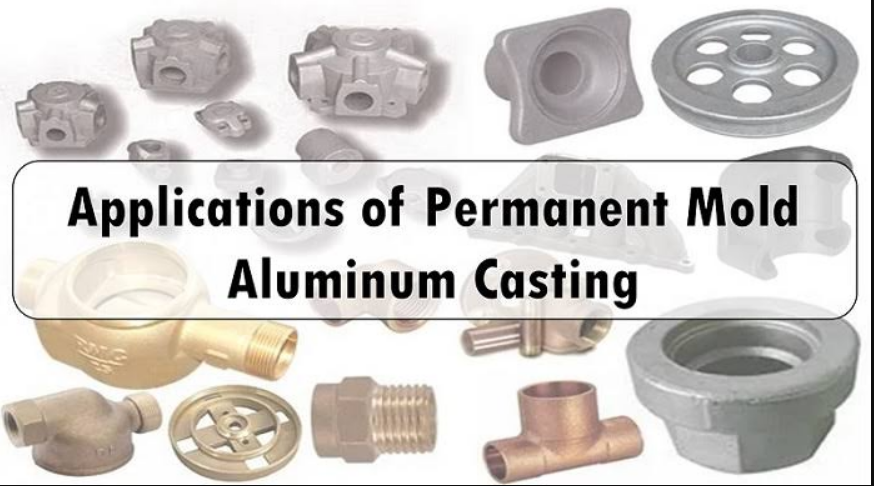
2. How Does the Permanent Mold Casting Process Work?
Permanent mold casting involves several carefully controlled stages, from mold preparation to the removal of the finished component. Proper temperature management, metal flow, and solidification control are essential for achieving consistent casting quality.
Step 1: Mold Design and Preparation
The process begins with designing and manufacturing a reusable metal mold. Typically, the mold consists of two or more sections that form the cavity corresponding to the required component geometry.
The mold incorporates essential features such as pouring channels, runners, gates, vents, and ejector mechanisms. These features help control molten metal flow, remove trapped gases, and facilitate casting removal.
Before production, the mold is cleaned, inspected, and preheated to an appropriate temperature. A refractory or ceramic-based coating is often applied to protect the mold surface, regulate heat transfer, improve metal flow, and prevent the casting from sticking.
Step 2: Molten Metal Pouring
Once the mold is prepared, the two mold halves are assembled and securely clamped together.
Molten metal is then introduced into the mold cavity through the gating system. Depending on the casting method, the metal enters under gravity or controlled low pressure.
The pouring temperature, filling speed, and metal flow must be carefully controlled to minimize turbulence, air entrapment, and premature solidification.
Step 3: Cooling and Solidification
After the mold cavity is filled, the molten metal begins to cool and solidify.
Because metal molds conduct heat more efficiently than sand molds, they generally promote faster and more controlled cooling. This can produce a finer grain structure and improved mechanical properties.
Cooling conditions must be properly managed to avoid defects such as shrinkage cavities, porosity, hot spots, and internal stresses.
Step 4: Mold Opening and Casting Removal
Once the metal has solidified sufficiently, the mold is opened and the casting is removed using ejector pins or other removal mechanisms.
The casting is then inspected, and excess material from gates, runners, and flash is removed. Additional operations, such as machining, trimming, heat treatment, or surface finishing, may be performed according to the product requirements.
Step 5: Mold Maintenance and Reuse
After casting removal, the mold is cleaned, inspected, and prepared for the next production cycle.
Regular maintenance helps prevent mold wear, surface damage, and dimensional variation, extending tooling life and ensuring consistent production quality.
3. Main Types of Permanent Mold Casting
Permanent mold casting includes several variations that differ mainly in how molten metal enters the mold cavity and how filling and solidification are controlled.
3.1 Gravity Permanent Mold Casting
Gravity casting is the most traditional permanent mold process. Molten metal flows into the mold cavity under the force of gravity without additional injection pressure.
The method is relatively straightforward and is suitable for aluminum and other non-ferrous alloy components with moderate geometric complexity.
Typical applications include automotive housings, pump components, valve bodies, and industrial machinery parts.
3.2 Low-Pressure Permanent Mold Casting
Low-pressure permanent mold casting uses controlled gas pressure to push molten metal upward from a sealed holding furnace into the mold cavity.
Compared with gravity casting, the controlled filling process reduces turbulence and air entrapment, helping produce denser castings with fewer internal defects.
This method is widely used for aluminum automotive wheels, suspension components, and other parts requiring reliable mechanical properties.
3.3 Vacuum-Assisted Permanent Mold Casting
Vacuum-assisted casting uses a vacuum system to remove air and gases from the mold cavity before or during metal filling.
Reducing trapped gases helps minimize porosity and improve the structural integrity of the finished components.
It is particularly useful for applications where internal quality and mechanical reliability are important.
3.4 Slush Casting
Slush casting is a specialized variation in which molten metal is poured into a mold and allowed to solidify along the mold walls. Excess liquid metal is then drained before complete solidification.
This produces hollow metal components without requiring a separate core.
Slush casting is generally used for decorative or relatively thin-walled hollow products rather than heavy structural components.
4. Materials Used in Permanent Mold Casting
Material selection is an important factor in permanent mold casting because different alloys have different melting temperatures, fluidity, shrinkage behavior, mechanical properties, and corrosion resistance.
Common materials include:
Aluminum Alloys: Lightweight, corrosion-resistant, and easy to cast. Aluminum alloys offer a good combination of strength, thermal conductivity, and dimensional stability, making them widely used in automotive, industrial, and electrical applications.
Magnesium Alloys: Extremely lightweight with a good strength-to-weight ratio. They are suitable for automotive, aerospace, and electronic components where weight reduction is important.
Zinc Alloys: Provide good fluidity, dimensional accuracy, and corrosion resistance. They are commonly used for small mechanical components, hardware, and fittings.
Copper Alloys: Offer excellent electrical and thermal conductivity, wear resistance, and corrosion resistance. They are used in plumbing fittings, electrical components, and industrial equipment.
The choice of alloy depends on the component's intended application, required mechanical properties, operating environment, and production budget.
5. Advantages of Permanent Mold Casting
Permanent mold casting offers several benefits for manufacturers producing metal components in medium to high quantities.
5.1 Reusable Molds and Lower Long-Term Production Costs
Unlike expendable molds, permanent metal molds can be reused for many production cycles. Although the initial tooling investment is relatively high, the cost can be distributed across a large production quantity.
This makes the process economically attractive for repeat orders and long-term manufacturing programs.
5.2 Better Surface Finish
Metal molds provide smoother cavity surfaces than conventional sand molds, resulting in castings with better surface finishes.
This can reduce the need for extensive grinding, polishing, and other finishing operations, helping save production time and costs.
5.3 Improved Dimensional Accuracy
Permanent mold casting generally offers better dimensional consistency and tighter tolerances than sand casting.
The rigid metal mold maintains its shape throughout repeated production cycles, helping manufacturers produce components with more consistent dimensions.
5.4 Improved Mechanical Properties
The relatively high thermal conductivity of metal molds promotes faster cooling and solidification.
This can result in finer grain structures and improved mechanical properties, including strength and hardness, depending on the alloy and cooling conditions.
5.5 Consistent Production Quality
Because the same mold is reused, manufacturers can maintain more consistent component geometry and quality across production batches.
When combined with proper process control and mold maintenance, permanent mold casting is suitable for applications requiring repeatable manufacturing results.
5.6 Reduced Material Waste and Post-Processing
Reusable tooling, controlled metal flow, and improved dimensional accuracy can help reduce material waste and machining requirements.
These benefits contribute to better production efficiency, especially when manufacturing large quantities of identical components.
6. Disadvantages and Limitations of Permanent Mold Casting
Despite its advantages, permanent mold casting is not suitable for every metal component or production requirement.
6.1 High Initial Tooling Investment
Manufacturing permanent metal molds requires specialized materials, precision machining, and engineering work.
The initial investment is generally higher than that of sand casting. Therefore, the process may not be economical for small production quantities or frequently changing product designs.
6.2 Limited Design Complexity
Permanent mold casting is less suitable for components with extremely complex geometries, intricate internal cavities, or undercuts.
Although cores and multi-part molds can accommodate certain complex features, these additions increase tooling complexity and production costs.
6.3 Material Limitations
The mold must withstand repeated exposure to high temperatures and thermal cycling. Consequently, permanent mold casting is generally more suitable for non-ferrous alloys with relatively low melting temperatures.
It is not typically used for conventional steel or iron castings because of the severe thermal demands placed on the mold.
6.4 Mold Wear and Maintenance
Repeated heating, cooling, and contact with molten metal gradually cause thermal fatigue, surface erosion, and mold wear.
Regular inspection, cleaning, coating renewal, and maintenance are necessary to maintain mold performance and casting quality.
6.5 Production Size and Wall Thickness Restrictions
Permanent mold casting has limitations when producing extremely large components, very thin walls, or intricate internal structures.
The design must allow molten metal to fill the cavity properly and solidify without creating excessive shrinkage or other casting defects.
6.6 Longer Cycle Times Compared with High-Pressure Die Casting
Although permanent mold casting can achieve relatively efficient production, its filling and cooling cycles are generally slower than high-pressure die casting.
For extremely high-volume production requiring short cycle times, high-pressure die casting may be a more suitable alternative.
7. Permanent Mold Casting vs. Sand Casting vs. Die Casting
Permanent mold casting occupies a middle position between sand casting and high-pressure die casting. Each process has different advantages depending on production volume, component complexity, tooling investment, and quality requirements.
| Comparison | Sand Casting | Permanent Mold Casting | High-Pressure Die Casting |
|---|---|---|---|
| Mold type | Expendable sand mold | Reusable metal mold | Reusable metal die |
| Filling method | Gravity or other methods | Mainly gravity or low pressure | High pressure |
| Initial tooling cost | Low | Medium to high | High |
| Surface finish | Relatively rough | Good | Very good |
| Dimensional accuracy | Moderate | Good | High |
| Production volume | Low to medium | Medium to high | High to very high |
| Design flexibility | High | Moderate | Moderate |
| Wall thickness capability | Relatively thick | Moderate | Thin |
| Mold lifespan | One casting cycle | Hundreds to thousands of cycles | High-volume reusable tooling |
Which Casting Process Should You Choose?
Sand Casting: Best for low-volume production, large components, and complex geometries where lower tooling investment is important.
Permanent Mold Casting: Best for medium- to high-volume production of non-ferrous components requiring good surface quality, dimensional accuracy, and consistent mechanical properties.
High-Pressure Die Casting: Best for high-volume production of relatively thin-walled, complex components where fast cycle times and high dimensional precision are essential.
The most suitable method depends on the balance between tooling costs, production quantities, component design, material requirements, and final product specifications.
8. Applications of Permanent Mold Casting
Permanent mold casting is widely used across industries that require durable, dimensionally consistent metal components.
Automotive Industry
Common applications include:
Engine housings and cylinder heads
Transmission housings
Intake manifolds
Automotive wheels
Suspension components
Industrial Machinery
Permanent mold casting is used to manufacture:
Pump bodies and housings
Valve components
Gearbox housings
Machine frames and structural parts
Hydraulic equipment components
Electrical and Electronics Industry
Typical applications include:
Electrical enclosures
Heat sinks and heat exchangers
Motor housings
Conductive components
Equipment housings
Plumbing and HVAC Industry
Common products include:
Pipe fittings
Valve bodies
Pump components
Heating and cooling system parts
Water distribution components
Aerospace and Marine Industries
Selected aluminum and magnesium castings are used in:
Lightweight equipment housings
Marine hardware
Propeller components
Structural brackets
Specialized machinery components
Material selection and casting quality must be matched to the specific safety, environmental, and performance requirements of each application.
Dongrun Casting has 20000 square meters of facility houses and 200 production & test equipment, From quotation and tooling design to casting and finished machining, we can work with you at every stage. We serve a wide range of industries-from Fortune 500 corporations to small and midsize OEMs. Our products include Automotive&trucking, Electric Utility & Communications, Metering Systems, the Hydraulic Industry, Medical Devices, Lighting, Fuel and Gas Pressure, and Furniture parts.
More Details: www.dongruncasting.com